The Pact Worlds
The Pact Worlds system is the heart of known civilization in the galaxy. Centered around the star known as the Sun, this system is home to a diverse array of worlds united under the Pact Worlds agreement — a fragile but enduring alliance forged in the wake of the Gap. Current membership includes planets, stations, worldships, and protectorates, along with self-governing moons and recognized entities such as the Aspis Consortium. The member world of Pulonis, located outside the Pact System, is the only member not physically part of this star system.
CELESTIAL BODIES (15)
The Sun
The Burning MotherKnown also as Mataras — a Lashunta name meaning 'burning mother' — the Sun is an incredibly inhospitable star of near-incomprehensible heat and pressure. In its heart, massive energies regularly tear holes to the Positive Energy Plane and the Plane of Fire, giving birth to whale-like fire elementals and plasma oozes, as well as efreet, salamanders, and intelligent flame-dwelling creatures with supernatural resistance to the star's conditions. Roughly a century ago, Sarenite scholars discovered the Burning Archipelago: a collection of inexplicable, deserted bubble-cities tethered together by magic and floating unburnt within the sun's flaming seas, accessed via a magical tunnel that opens miraculously through the corona. Though it remains unknown who built these cities, the Burning Archipelago quickly became the Church of Sarenrae's most sacred settlement. Today, the Radiant Cathedral in the central bubble attracts worshipers and scientists from across the system, while gleaming Sarenite sunskimmers service orbital power stations and corporations operate solar-powered robotics plants and 'jungle boxes' of mutated organisms. Trade delegations from the Plane of Fire regularly use the Archipelago to meet Material Plane contacts, and they bring word of strange ruins and whole empires of fire-immune creatures floating within the star's deeper layers — the so-called 'deep cultures' whose refusal to respond to messages has spawned conspiracy theories suggesting that time itself warps at the sun's core, making these civilizations representatives not of the past but of the future.

Aballon
The ForgeThe closest planet to the sun, Aballon is a drab world of dusty craters, gray deserts, and sharp-edged mountains. What wisps of atmosphere its gravity clings to are quickly blasted away by solar wind. Thousands of years before either the Gap or common spaceflight, a mysterious race called the First Ones touched down on Aballon, crafted an immense army of servitor machines using the planet's abundant metals and solar energy, and then left. In the millennia since, the machines upgraded themselves, evolving into an entire artificial ecosystem — from simple worker bots and self-guided predator drones to fully sentient machines collectively named anacites, who tend toward silvery arthropod bodies painted in identifying colors and patterns. Anacite culture splits into two ideological groups: Those Who Wait, who stockpile wealth and resources believing the First Ones will return, and Those Who Become, who believe their destiny is to take on the First Ones' mantle and colonize new worlds. Both groups wield considerable economic power through rare ore mining in the Midnight Trenches and anacite-run corporations like Automatrix Robotics. Anacite cities, often confusing to biological creatures, are nonetheless eminently logical and efficient, with floating towers, lightless access tunnels, and atmosphere factories producing 'heavy air' for humanoid visitors.
Castrovel
The WildHot, humid, and stirred by intense storms and tides, Castrovel abounds with an unusually robust variety of life, from enormous saurian beasts to deadly moldstorms capable of devouring whole settlements. The most prominent sentient races are lashuntas, followed closely by elves and formians, all three civilizations highly connected via a network of ancient magical teleportation portals called aiudara. Traditionally organized into independent city-states with elected matriarchies being the most common governmental style, lashunta society has evolved in the modern era with larger corporate concerns often buying out officials or establishing privatized settlements. The insectile formians battled lashuntas for millennia until careful shirren-brokered peace talks ended hostilities a mere 30 years ago; today the formian hive-burrows of the Colonies can cover miles, sometimes bulging up in artificial honeycombed hills. The elves of Sovyrian are predominantly xenophobic traditionalists who trade with outsiders only when necessary and bar most foreigners from their canal-choked capital of El. The planet's vast ecological preserves reflect Castrovel's enlightened approach: maintaining wilderness is key to advancing knowledge and allowing evolution to continue. The planet's primary shipyards and most destructive heavy industries are relegated to its airless, rocky moon Elindrae, while a strong Xenowarden presence keeps ecological damage in check.

Absalom Station
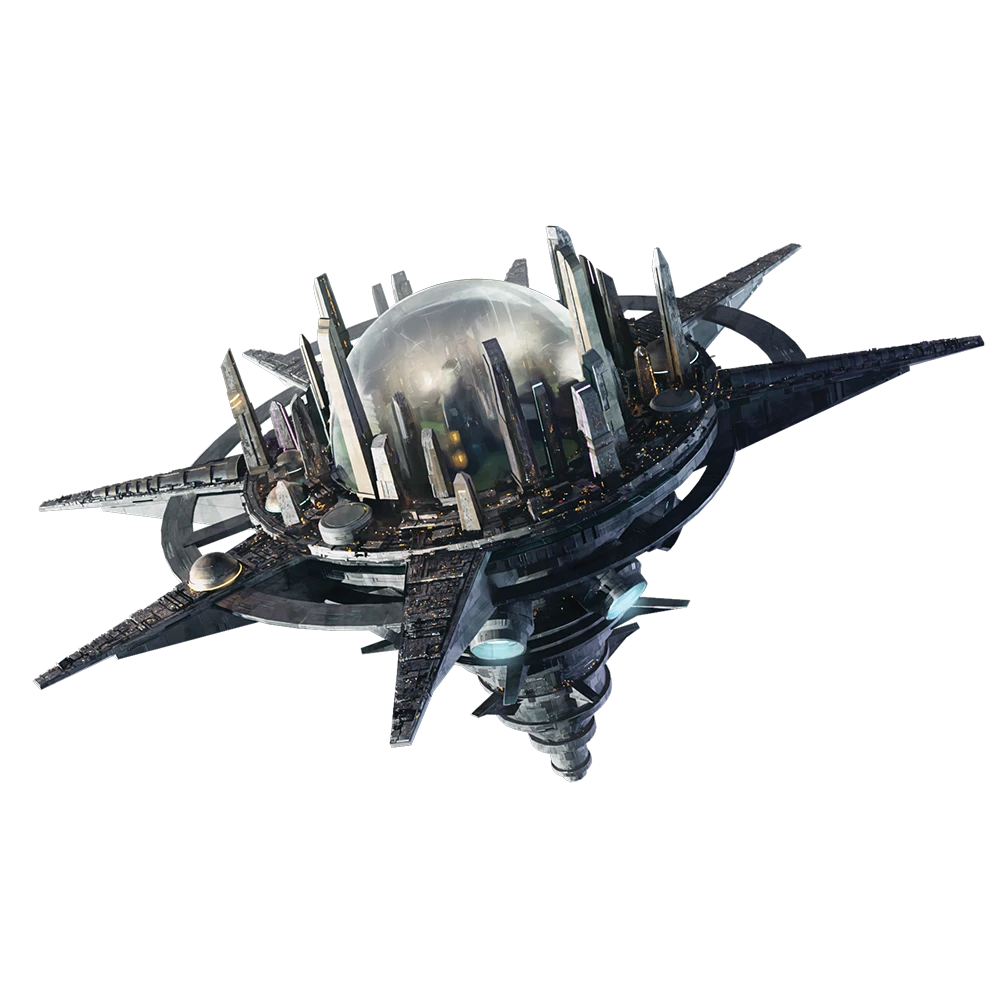
The NexusOrbiting in the place of missing Golarion, Absalom Station is the sociopolitical and economic center of the Pact Worlds, a fortress around the Starstone, and the galaxy's preeminent hub of travel, trade, politics, and culture. The Starstone serves as both a seemingly inexhaustible reactor and a powerful Drift beacon, allowing travel to the station from anywhere in the galaxy in less than a week. No one fully understands who built the station or how its deepest systems interface with the artifact below. At the transparent dome center known as the Eye, parks and corridor gardens are woven through skyscrapers hundreds of stories tall. Jatembe Park rings the district like an iris, while institutions such as the Plenara, Kemanis University, and the Arcanamirium anchor the station's political and intellectual life. Extending out from the Eye is the Ring, where districts like Drifter's End, the Freemarkets, and the Congregation draw travelers with food, lodging, entertainment, private security hiring, and near-endless commerce. Beyond the Ring are the Arms, where docks and bays connect visitors to neighborhoods tailored to radically different life-support needs, from Fogtown and the Puddles to the Vesk Quarter and Little Akiton. Ships that do not dock join the semi-permanent Armada, where minimally taxed businesses operate in exchange for helping defend the station. Beneath it all hangs the Spike, which contains the station's critical infrastructure and Starstone interface but is packed with hazards: unstable systems, strange leakages, gang territories, scavenger settlements, and the flickering liminal region called the Ghost Levels. The station remains in uneasy recovery after the Newborn crisis triggered a system-wide blackout and intense Ghost Levels activity. Daily life is still vibrant and diverse, with communities from across the Pact Worlds and beyond sharing culture, faith, work, and art, but fears over energy instability, gang conflict, and external threats remain high. Primex Kantol's administration, the Stewards, civic factions, mystics, and engineers are all under pressure to secure Absalom Station's future before another shock tests the station's defenses and leadership.
Akiton
The BattlefieldDespite its favorable location as the fourth planet from the sun, Akiton is a dying world. The so-called Red Planet has lost much of the atmosphere and liquid water it once held due to the slowing of its liquid-iron core and weakening magnetosphere. Prior to the discovery of hyperspace, Akiton was the center of its system's mining, production, and trade of thasteron — an ore instrumental in creating fuel for sublight interplanetary travel. Since the advent of Drift travel, demand for thasteron has crashed, and the economic effects now play out in political squabbles and civil strife across the planet. Massive space barges that once shuttled ore now lie as rusting hulks in the deserts, inhabited by squatters and scavengers. Akiton today has no centralized government, and its cold deserts, dry seabeds, and frigid polar ice caps host never-ending skirmishes between cities, clans, corporations, tribes, and offworld factions. It's a world where unscrupulous business interests engage in unregulated research and criminals come to escape justice. The best-known indigenous residents are the ysoki, boisterous ratfolk who thrive in warren-districts or motorized traveling caravans, inevitably returning to the vast Hivemarket at the foot of Ka, Pillar of the Sky. The four-armed giant shobhads have seen a resurgence as their traditional desert life sidestepped the economic collapse, while the Contemplatives of Ashok — telekinetic beings whose physical bodies have nearly withered in favor of throbbing brain sacs — decipher esoteric truths in their legendary Halls of Reason.
Verces
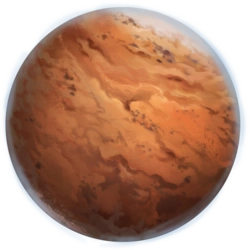
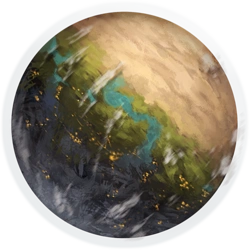
The LineA tidally locked world, Verces has no day or night — only a scorched light side called Fullbright, where iron-hard plants and photosynthesizing animals survive, and the partly frozen seas of Darkside, home to predators like hoarbats and the infamous bloodbrothers. Between these extremes runs the Ring of Nations, a temperate zone along the twilit terminator filled with gleaming skyscrapers, bustling spaceports, vertical park-farms, and high-speed bullet trains. The native verthani are tall humanoids with color-changing skin and mouselike black eyes, long at the forefront of cybernetics due in part to their traditional caste system: the technology-augmented Augmented warriors, the unmodified Pure Ones who handled governance and food production, and the scarred God-Vessels who served as living avatars of deities. Though the caste system is now considered archaic, many still credit it with giving Verces its head start in implant technology. Verthani were also among the first races to adopt space exploration, voyaging in dirigible-like aetherships, and their massive shipyards at Skydock remain second to none. The Ring of Nations' government model — a coalition forming a single worldwide Grand Assembly — so impressed the other worlds that the Pact Worlds adopted both its structure and its peacekeeping Stewards. Beyond the terminator zone live the Outlaw Kingdoms: nomadic tribes, survivalist cults, criminal organizations, and political exiles generally ignored unless they raid Ring settlements. Even within their territory, vast stretches of untouched wilderness remain, including the mysterious Qidel, Aerie of the Sun — a strange tube-spire descending deep into the planet's mantle from which no expedition has returned.
Idari
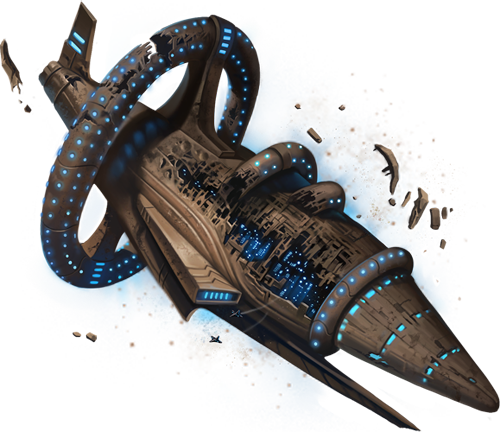
The RenewalThe single largest ship ever produced by Kasath, the Idari was a generation vessel designed to transport whole generations at a fraction of light speed. When it reached its destination of Akiton and found the world too populated — and too well defended — for colonization, the ship took up orbit past Verces and declared itself a Pact World in its own right. Unlike Absalom Station, the Idari has not become a melting pot, remaining inhabited primarily by kasathas governed by traditional values. The ship's massive reaction drives haven't fired in decades, their power rerouted to the Crucibles, an impressive state-run manufacturing sector. Artificial gravity comes from the vast rotating cylinder called the Drum, whose curving landscape hosts gleaming cities, rolling parks, and glass-walled hydroponic farm-towers under constant daylight rerouted from hull-mounted solar collectors. Through the Drum's center runs the Hub, a zero-gravity transport tube with elevator spurs providing rapid access to any location. The traditional Doyenate governs the ship: a representative council of the most respected members across various fields, where status is never inherited but recognized by the people. Citizens residing on the ship for more than a year must accept and train for an auxiliary crew role. The Sholar Adat, a cathedral-like spire in Brispex stretching nearly to the Hub, acts as a combination cemetery, library, and ancestor temple. Through the process called adat, a hair-thin slice of a deceased's brain is preserved and added to the temple's archives, where the building's technomagical machinery can kindle flashes of the deceased's memories or even contact the departed soul.
The Diaspora
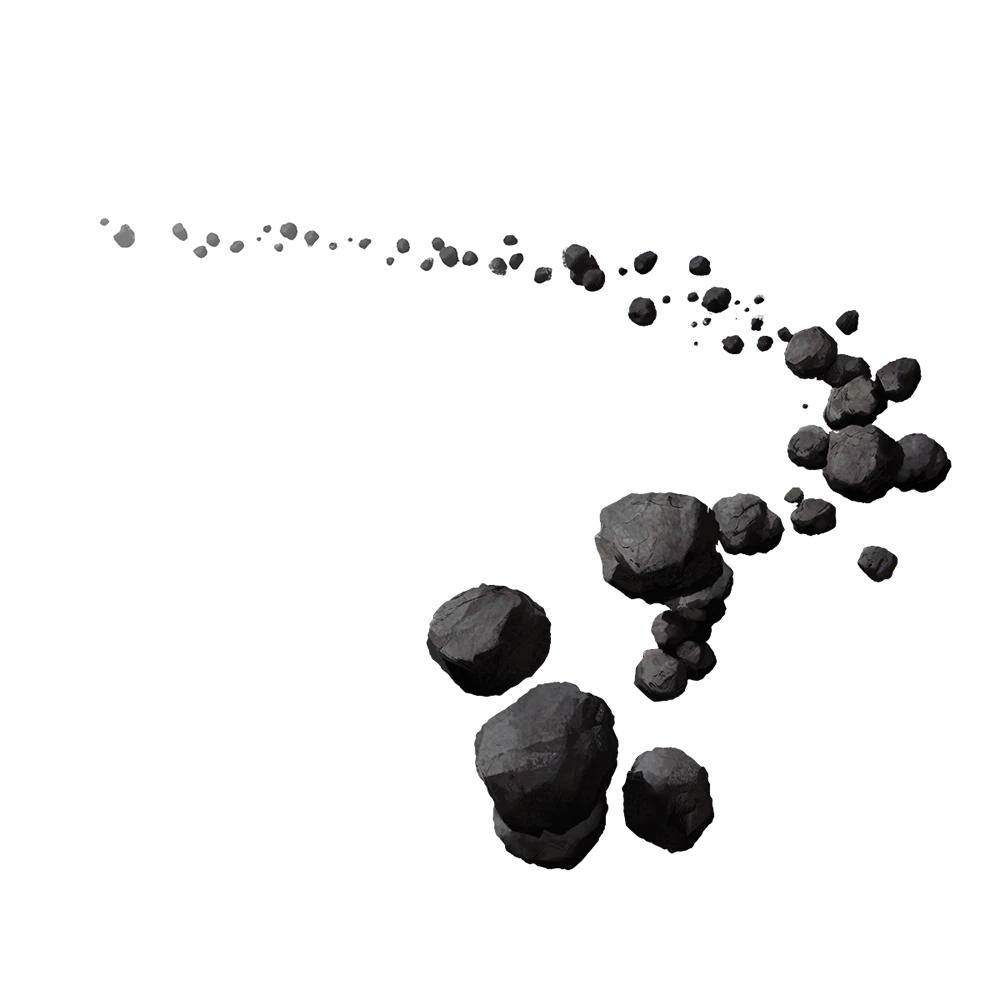
The Lost OnesFormed when the twin planets Damiar and Iovo were destroyed by an unknown catastrophe millennia ago, the Diaspora is a vast asteroid belt containing more than a million celestial bodies with diameters greater than a mile. The true indigenous residents are the sarcesians — tall, graceful humanoids who evolved to survive in hard vacuum, able to suspend respiration indefinitely while soaring between lonely asteroids on wings of pure energy stretched to catch the solar wind. Sometimes called 'angels,' the sarcesians maintain carefully terraformed 'crèche worlds' within the belt and have never forgotten their ancient feud with Eox, which they believe destroyed the Twins. The Diaspora also harbors smugglers and space pirates — especially the infamous Free Captains of Broken Rock — and mineral-rich planetoids claimed by mining companies, notably several dwarven Star Citadels. Androids calling themselves the Refugists have recently begun constructing their own homeworld by pulling together asteroids with tractor beams and gravity guns. With 600 miles in diameter, Nisis is the largest body in the Diaspora — an ice-crusted planetoid of mostly fresh water and the source of the River Between, a strange waterway surrounded by atmosphere in a cylindrical containment field connecting many asteroids. Recently, the water has turned dark and attacks by unseen 'diaspora wyrms' have sent traffic plummeting, coinciding with Nisis mysteriously growing in size. Among famous locations are the House of the Void monastery and the empty Wailing Stone, whose abandoned corridors drive visitors to nightmares and visions of twisted figures in yellow rags.
Eox
The DeadEox was once a beautiful and technologically advanced world, homeworld of the humanoid elebrians. In a catastrophic act of pride, the elebrians developed a superweapon to destroy the twin worlds of Damiar and Iovo — now the Diaspora — and in doing so unleashed calamitous energies and radiation that scoured their own world, stripping its atmosphere and rendering the surface a blasted wasteland laced with runaway magical radiation. The elebrians who survived did so by embracing undeath, transforming themselves into the bone sages who rule the planet to this day. While the surface is inhospitable to living creatures, vast necropoli teem with undead activity, and research into necromancy and bodily augmentation — particularly necrografts — continues as a thriving industry. Perhaps the greatest danger from Eox is the Corpse Fleet: a rogue military faction of Eoxian warships that broke away from the bone sages' authority, raiding and plundering across the system while the bone sages officially deny all connection. Orbiting Eox is the Sentinel, a massive weapons platform that the bone sages insist is purely defensive but which gives even the Stewards pause. On the surface, body merchants do a brisk trade in necrografts harvested from willing and unwilling donors alike. To maintain diplomatic relations, the bone sages created the Halls of the Living — a subterranean city with artificial atmosphere where living visitors can conduct business in safety, complete with gravity-controlled sports arenas, nightclubs, and reality holovision shows considered cruel and exploitative by most Pact World standards.
Triaxus
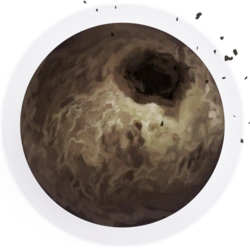
The WandererWith its extreme 317-year orbital period, Triaxus swings between centuries of bitter winter and decades of relative summer. The native ryphorians have adapted with genetic flexibility: winterborn ryphorians are pale-furred and stocky, summerborn are slender with dark skin, and transitional individuals display traits of both. The planet's civilizations divide roughly into the Allied Territories — nations governed by ryphorians — and the Drakelands, where chromatic dragons openly rule nations of ryphorian and dragonkin subjects. Most famous is the Skyfire Mandate, an order dating back to when ryphorians and dragonkin first bonded as rider and mount to fight off chromatic dragon warlords. Today the Skyfire Legion is an elite starfaring military company, their dragonkin partners having genetically reduced in size over generations to better fit aboard starships. The Allied Territories are themselves divided — the democratic nations of Kamora and Zo contrast with the isolationist city of Aylok and the fiercely traditional realm of Preita. On the continent of Ning, an honor-based culture produces the legendary ukara battleflowers: renowned warriors who serve as living weapons for noble houses, their social status matched only by their combat prowess. Above it all, the Immortal Suzerain — an ancient silver dragon — watches over the Allied Territories as a mediating force. Despite its long history of dragon-ryphorian conflict, modern Triaxus is a world where the two species' fates are inextricably linked.
Liavara
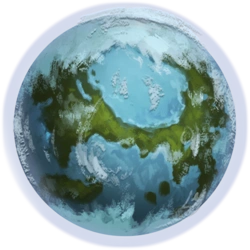
The DreamerThe smaller of the system's two gas giants, Liavara is a ringed world of pastel clouds and eerie beauty, administered as a protectorate by Bretheda. Deep within its atmosphere dwell the Dreamers — barathus who have either devolved or ascended into massive, mindless hive-blimps that sing hauntingly beautiful prophetic songs. Whether the Dreamers represent enlightenment or degeneration is a matter of fierce philosophical debate among brethedans. The giant oma — space-dwelling whale-like creatures that swim the cosmic void between worlds — are often found in Liavara's orbit, their young sometimes descending into the atmosphere. Liavara's cloud ecosystem is astonishingly complex, with entire food chains existing in the layered atmosphere, and corporations mount expensive deep-dive expeditions to harvest rare gases like metasterium and thaumogen from its lower reaches, though the crushing pressures and hostile fauna make this perilous work. Bretheda administers Liavara protectively, investing resources to prevent exploitation even as Liavara's moons have charted their own political courses.
Bretheda
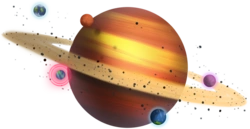
The CradleThe largest planet in the Pact Worlds system, Bretheda is the undisputed homeworld and seat of power for the barathus — amorphous, telepathic beings who can merge and split their bodies at will, creating temporary or permanent composite beings of staggering complexity. This biological flexibility extends to their technology: brethedans grow their tools, ships, and structures from living tissue, producing organic starships and habitat-pods rather than manufacturing them. Their government, the Confluence, is a unique political entity — a composite being formed when multiple barathus merge specifically to govern, splitting off specialized delegates embedded with proprietary biotech and self-destruction sequences to prevent defection. The Sopeth Corporation, one of the system's most powerful biotech firms, is in fact a single permanently merged barathu entity. Bretheda's cloud layers teem with life, from microscopic organisms to city-sized living gas-bags, and the barathus' deep understanding of their ecosystem has given them unparalleled expertise in biological engineering. Several of Bretheda's moons have achieved independent member status, though the gas giant also claims responsibility for the so-called 'death moons' Thyst and Varos — quarantined worlds harboring dangers too great for colonization.
Apostae
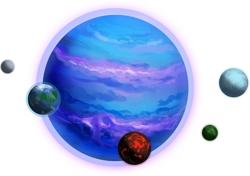
The MessengerWith its angled orbit slicing through the plane of the solar system, many astronomers believe Apostae is not native to the Pact Worlds system at all — that it is, in fact, a derelict generation ship of extrasolar origin. Beneath the barren, airless surface lies a vast interior of artificial corridors, sealed chambers, and ancient alien technology built by the vanished ilee, a race now known only from skeletal remains and cryptic inscriptions. The drow who now control the world claim to have fled Golarion before or during the Gap, guided by demons to this hollow world. House Zeizerer holds the most power among the competing noble houses, which ruthlessly vie for control of newly discovered passages and technology vaults. Orcs and half-orcs, brought as slaves, occupy a permanent second-class status, performing dangerous exploration and manual labor. Two particular mysteries drive Apostae's politics: the Armory — a legendary cache of ilee weapons rumored to be planet-destroyingly powerful — and the Chamber of Life, believed to hold the secret of what happened to the ilee themselves. The surface settlement of Nightarch is named for a massive alien arch covered in undeciphered markings that occasionally generates random portals to unknown locations, a phenomenon the drow study obsessively but cannot replicate.
Aucturn
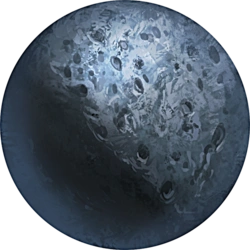
The StrangerThe most distant and disturbing world in the Pact system, Aucturn was once a living planet of shifting, organic flesh — a place where the very ground pulsed and breathed beneath a toxic atmosphere of hallucinogenic gases. Known as the Stranger, its surface was covered in fleshy ridges, orifices, and organic structures, and pools of black ichor dotted the landscape, transforming any creature that touched them into alien monstrosities called orocorans. The planet's ruler, Carsai the King, maintained a fragile order from the Citadel of the Black, while cults of the Elder Mythos — including the Pyramid of the Black Pharaoh dedicated to Nyarlathotep — competed with agents of the Dominion of the Black for influence over the world's unknowable purposes. Living settlements like Amniek, a tower-city where residents breathed filtered air and avoided the surface, clunged to survival alongside horrors like the Gravid Mound, a fleshy hill tended by sinister beings called the Midwives. In 324 AG, the terrible truth was revealed: Aucturn was the egg of a nascent Outer God now known as the Newborn. The entity that hatched destroyed the planet utterly, ending Aucturn's existence and leaving only a debris field and lingering psychic screams where the Stranger once orbited.
Pulonis
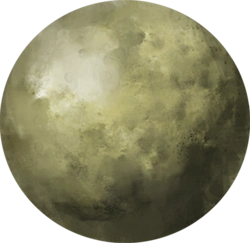
Formerly Vesk-6Pulonis — formerly designated Vesk-6 by the Veskarium — is the sixth planet in the Ghavaniska system and the homeworld of the catlike pahtras. An inexplicably warm jungle world despite its distance from the sun Ghavaniska, the planet is hot and humid, with its low gravity producing towering trees, gigantic insects, and other titanic flora and fauna locked in ruthless competition. Pulonis threw off Veskarium control in 325 AG and became the first full member of the Pact Worlds government outside the Pact system that same year. A powerful magnetosphere helps the planet retain its atmosphere, but the magnetic winds it generates devastate many forms of technology — most starships, vehicles, and buildings are one system failure away from complete destruction. As a result, much of the surface remains untamed, and the planet's few modern settlements rely on heavy magnetic shielding to function. Residents must often travel hundreds of miles to visit a digitized library or advanced medical facility. Pulonis is a small, lush terrestrial world with a single supercontinent making up the majority of its land. The planet lacks ice caps, and its hot climate is nearly uniform across all latitudes. Its low gravity has allowed truly towering flora to evolve, with forests reaching as high as mountain ranges on other worlds, while the actual mountains are even taller with jagged peaks that seem impossibly steep to offworlders. Though technically having only one ocean, cartographers split the seas into three major bodies: the relatively safe Ketemare Ocean, the Tideflight Ocean and Tereltos Sea, known for dangerously extreme tides caused by the pull of the planet's twin moons — Hinirinn and Yolaku. Near the center of the continent lies a blasted rocky plain where the worst fighting of the Veskarium invasion took place; pahtras call this the Holy Lands, in honor of all who died fighting there. Recent investigation has unveiled that the planet's core appears to have been altered in its prehistoric past, allowing it to maintain warm temperatures despite its distance from the sun. Most theories posit that an unknown advanced alien species was responsible for this planetary engineering, but no proof of these aliens has been found anywhere in the Veskarium, and no ancient ruins have been discovered on Pulonis. Pahtras are lanky feline humanoids who evolved in the low gravity to be swift predators. They conquered their environment through adaptability, ferocity, and training rather than strength, thriving within a brutally competitive ecosystem. Pahtra culture reveres battle and music as the two most prestigious callings, often combining the two. Since gaining independence, the planet's pahtra nation-states have flourished with greater autonomy, though the lingering effects of Veskarium occupation and the ever-present dangers of the planet's magnetic fields and megafauna remain constant challenges. Pulonis is also home to hymothoas, sapient ichthyoid oozes that lurk in the most humid swamps. Despised by both vesk and pahtras, these bulbous creatures are known to crawl inside other sapient beings, slowly devouring their host's organs while adapting to replace their function.